
Rung 3 · See the loop
Divide voltage in series
Use two series resistors to see shared current and proportional voltage drops.
Knowledge this exercise builds on
Practice loop
Try each step before revealing its answer.
The task stays visible. Revealing a numbered answer remembers that stage as explored in this browser. It is not a grade.
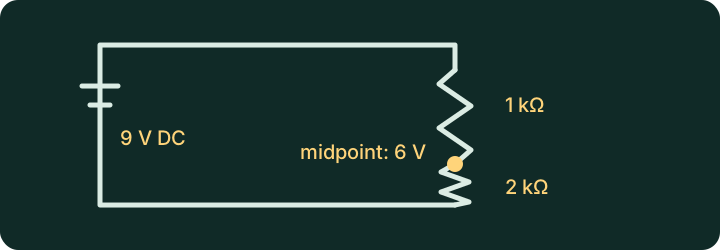
- One 9 V DC voltage source
- One 1 kΩ resistor
- One 2 kΩ resistor
- One midpoint probe and one ground reference
Predict the total resistance, loop current, voltage across each resistor, and midpoint voltage relative to ground.
Reveal predictionHide prediction
The series resistance is 3 kΩ, so the loop current is 3 mA. The 1 kΩ resistor drops 3 V, the 2 kΩ resistor drops 6 V, and the midpoint is 6 V above ground.
Connect the 1 kΩ resistor above the midpoint and the 2 kΩ resistor between the midpoint and ground.
Show build checkHide build check
The path should be:
9 V source -> 1 kΩ -> midpoint -> 2 kΩ -> groundBoth resistors must share the same single current path. Place the midpoint probe at their connection.
Measure the loop current, each resistor drop, and the midpoint voltage relative to ground. Check whether the two drops add back to the source voltage.
Reveal expected resultHide expected result
loop current  -> 3 mA
1 kΩ resistor -> 3 V
2 kΩ resistor -> 6 V
midpoint      -> 6 V above ground
The drops add to the 9 V supplied by the source.
Explain why both resistors carry the same current but do not receive the same voltage drop.
Reveal explanationHide explanation
Series components share one current path, so both resistors carry 3 mA. Each drop is V = IR, so the 2 kΩ resistor drops twice as much voltage as the 1 kΩ resistor.
Optional referenceReveal reference circuitCompare only after you build. Opening this panel does not contact Falstad.
The reference is editable and uses the same export text as the external link. Loading it contacts falstad.com. The written exercise and schematic remain useful if Falstad is unavailable.
Safety boundary
This is a low-voltage educational model.
Do not translate it into mains construction, household wiring, battery-pack work, or real protection settings. Real electrical systems need rated components, proper protection, test equipment, and qualified safety judgment.