
Rung 6 · See change over time
Let one AC half-cycle through
Use one diode to turn a reversing AC waveform into pulsing one-direction output.
Knowledge this exercise builds on
Practice loop
Try each step before revealing its answer.
The task stays visible. Revealing a numbered answer remembers that stage as explored in this browser. It is not a grade.
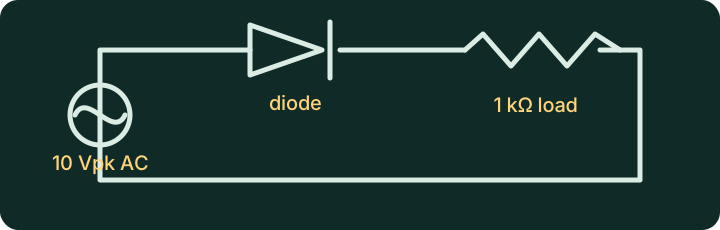
- One 10 V peak, 50 Hz AC voltage source
- One diode
- One 1 kΩ load resistor
- Input and output scopes
Draw the expected source waveform and load waveform. Decide what happens during the half-cycle that reverse-biases the diode.
Reveal predictionHide prediction
The diode conducts during one half-cycle and blocks the other. The load sees pulses of one polarity, reduced slightly by the diode’s forward voltage. During the blocked half-cycle, load current is approximately zero.
Place the diode in series between the AC source and load. Keep the diode orientation unchanged for the first run.
Show build checkHide build check
Use one series path:
AC source -> diode -> 1 kΩ load -> source returnPlace one scope across the source and another across the load. Reversing only the diode should reverse which half-cycle reaches the load.
Compare the source and load scopes. Record the output during both source polarities, then reverse the diode and repeat.
Reveal expected resultHide expected result
With the first orientation, one half-cycle appears across the load and the reverse half-cycle stays near zero. Reversing the diode passes the opposite half-cycle. The conducting pulse is slightly smaller than the source because of the diode’s forward drop.
Explain why this output is pulsing DC rather than steady DC.
Reveal explanationHide explanation
The diode is a direction-sensitive path. It blocks one half-cycle and conducts during the other, so the load current no longer reverses.
The direction is fixed, which makes the output DC, but its magnitude still rises and falls to zero, which makes it pulsing rather than steady.
Optional referenceReveal reference circuitCompare only after you build. Opening this panel does not contact Falstad.
The reference is editable and uses the same export text as the external link. Loading it contacts falstad.com. The written exercise and schematic remain useful if Falstad is unavailable.
Safety boundary
This is a low-voltage educational model.
Do not translate it into mains construction, household wiring, battery-pack work, or real protection settings. Real electrical systems need rated components, proper protection, test equipment, and qualified safety judgment.