
Rung 5 · See change over time
Watch an RC circuit remember
Charge and discharge a capacitor through a resistor while following voltage and current over time.
Knowledge this exercise builds on
Practice loop
Try each step before revealing its answer.
The task stays visible. Revealing a numbered answer remembers that stage as explored in this browser. It is not a grade.
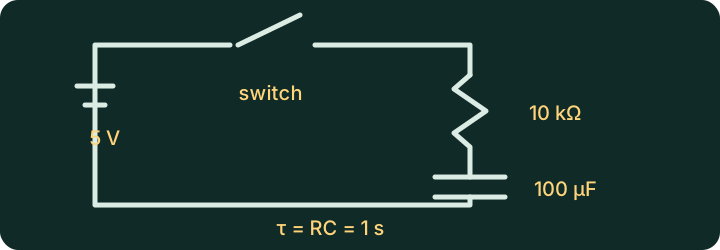
- One 5 V DC voltage source
- One two-position switch
- One 10 kΩ resistor
- One 100 µF capacitor
- Two scopes, for capacitor voltage and resistor current
Predict whether capacitor voltage and current jump instantly when charging begins. Calculate the time constant with:
τ = R × CReveal predictionHide prediction
The time constant is:
τ = 10,000 Ω × 0.0001 F = 1 secondCapacitor voltage cannot jump instantly. Charging current can jump to 5 V / 10 kΩ = 0.5 mA, then falls as the capacitor charges.
Use the switch to connect the resistor either to 5 V for charging or to ground for discharging. Keep the capacitor connected to ground.
Show build checkHide build check
The resistor and capacitor stay in series, with the capacitor bottom connected to ground. The two-position switch should connect the resistor top to 5 V for charging or to ground for discharging.
Record capacitor voltage and resistor current at the start, after 1 second, and after several seconds. Switch to discharge and compare the shape and direction of the two traces.
Reveal expected resultHide expected result
After one time constant, capacitor voltage reaches about 63 percent of 5 V:
V₍C₎ ≈ 3.15 V after 1 secondCurrent starts near 0.5 mA and falls toward zero. During discharge, capacitor voltage decays smoothly and current reverses direction before also falling toward zero.
Explain what the capacitor stores, why the resistor limits the initial current, and why the waveform changes fastest at the beginning.
Reveal explanationHide explanation
The capacitor stores energy in an electric field and resists an instantaneous voltage change. The resistor limits current. The voltage difference across the resistor is largest at the beginning, so current and capacitor voltage change fastest then. Together, resistance and capacitance set the response time.
Optional referenceReveal reference circuitCompare only after you build. Opening this panel does not contact Falstad.
The reference is editable and uses the same export text as the external link. Loading it contacts falstad.com. The written exercise and schematic remain useful if Falstad is unavailable.
Safety boundary
This is a low-voltage educational model.
Do not translate it into mains construction, household wiring, battery-pack work, or real protection settings. Real electrical systems need rated components, proper protection, test equipment, and qualified safety judgment.